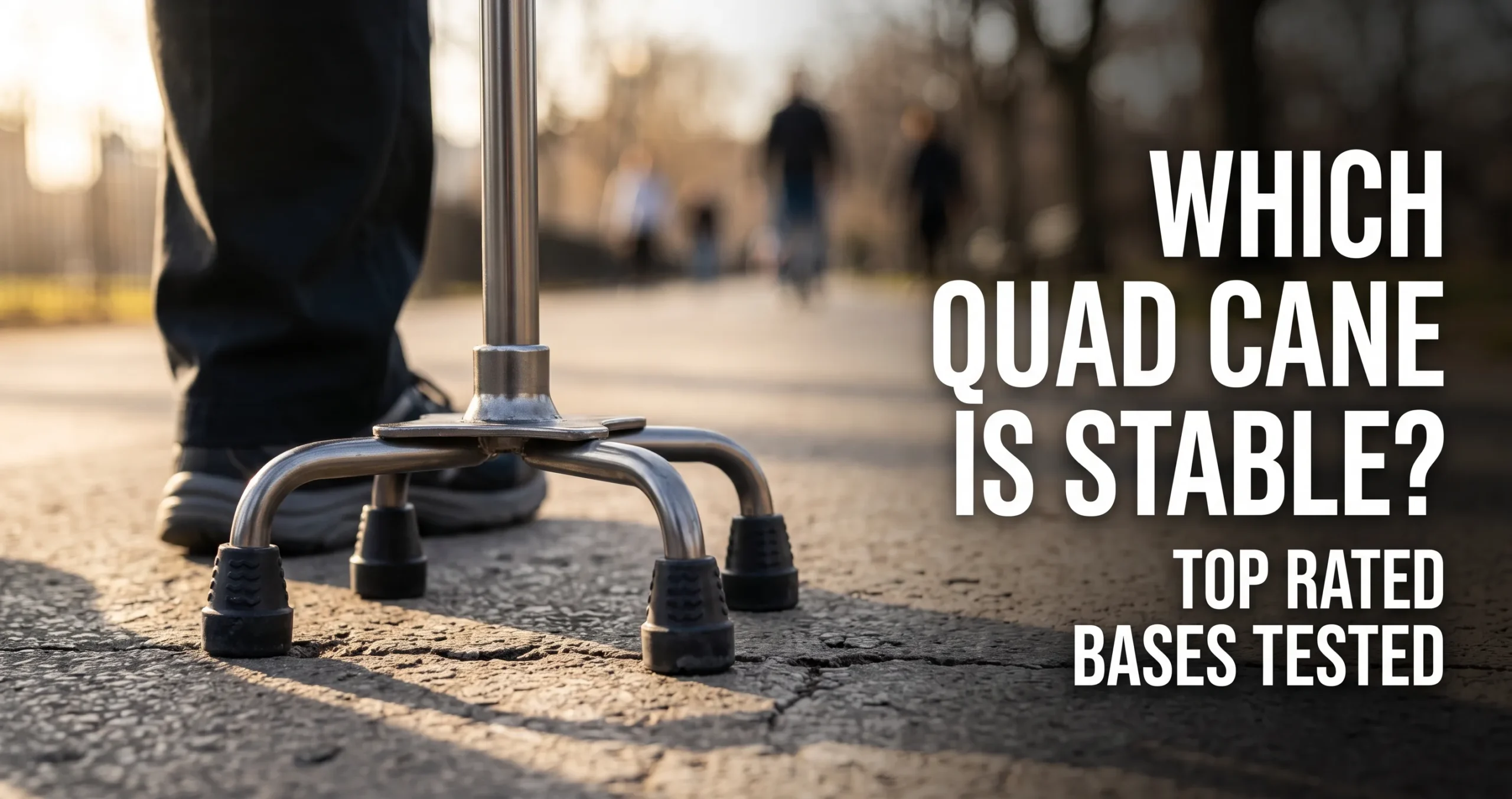
Short answer: a single-point cane is lighter and easier to carry, and it suits people who need a little help with balance. A quad cane has a four-legged base that stands on its own and spreads your weight over a wider area, so it suits people who need more support, such as after a stroke or with significant weakness on one side. If you are unsure, ask your physical therapist to watch you walk with both before you buy.

What is the difference, exactly?
Both canes do the same basic job: they take some weight off a weaker or painful leg and give you an extra point of contact with the ground. The difference is in the base.
- Single-point cane: one rubber tip on the end of the shaft. It is light, slim, and works on almost any surface, including stairs.
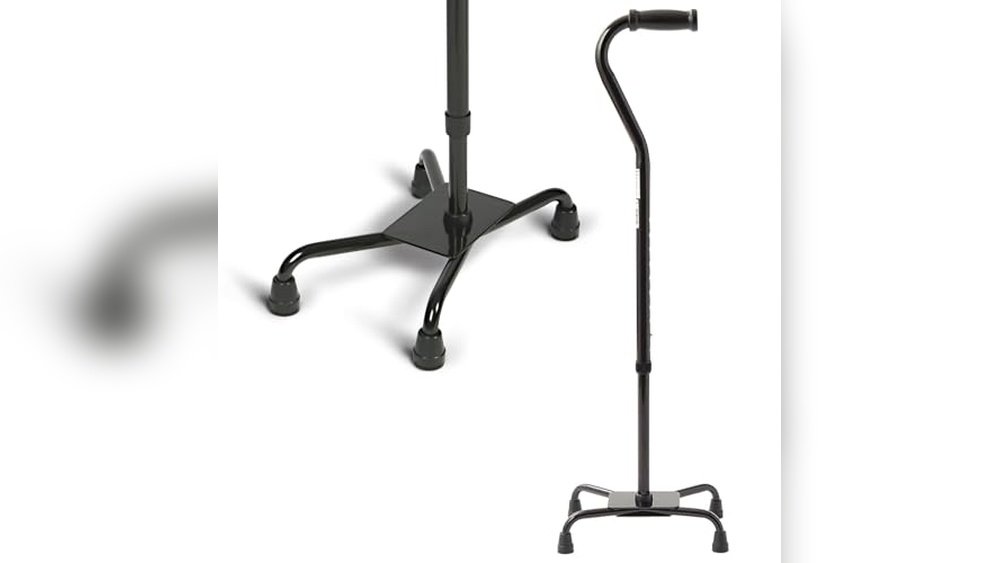
- Quad cane: a small platform with four short legs, each with its own rubber foot. It is heavier, but it can stand upright by itself and gives a much wider base of support.
Quad canes come in two base sizes. A small-base quad cane is a middle ground: more stable than a single tip, but still fairly compact. A large-base quad cane gives the most support of any cane, but it is bulky and harder to use on stairs and in tight spaces.
Side-by-side comparison
| Single-point cane | Quad cane | |
|---|---|---|
| Support | Light to moderate | Moderate to high |
| Weight | Lightest | Heavier, especially large-base models |
| Stands on its own | No (unless it has a special self-standing tip) | Yes |
| Stairs and curbs | Easy | Possible with a small base; awkward with a large base |
| Uneven ground, grass, gravel | Works well | Less stable: all four feet need to touch the ground |
| Walking speed | More natural pace | Usually slower |
| Travel and storage | Easy, and folding versions exist | Bulky; some models fold |
Who a single-point cane suits
A single-point cane is usually the right choice if:
- you feel a little unsteady, but you can walk without holding on to furniture;
- one knee or hip is sore, and you want to take some pressure off it;
- you are near the end of recovery from surgery and stepping down from a walker or quad cane;
- you walk outdoors a lot, on pavements, paths or grass;
- you want something light enough to hang on a chair or fold into a bag.
The MedlinePlus guide to using a cane (from the U.S. National Library of Medicine) describes a cane as a good choice when you only need a little help with balance and stability, or when your leg is only a little weak or painful.
Who a quad cane suits
A quad cane is usually worth considering if:
- one side of your body is clearly weaker, for example after a stroke;
- a single-point cane feels wobbly, or you find yourself leaning hard on it;
- you need the cane to stay upright while you use both hands, for example to open a door or stand up from a chair;
- you mostly walk indoors on flat floors.
If even a large-base quad cane does not feel steady enough, that is a sign to talk to your doctor or therapist about a walker. MedlinePlus also notes that crutches or a walker may be better options if you have a lot of pain, weakness or balance problems.
How to choose between them: 4 quick questions
- Can you walk across the room without touching furniture? If yes, start by trying a single-point cane. If no, try a quad cane, or ask about a walker.
- Where will you use it most? Mostly indoors on flat floors favours a quad cane. Outdoors, stairs and uneven ground favour a single-point cane.
- Do you need it to stand up on its own? If you often need both hands free for a moment, a quad cane helps.
- How strong is your grip and arm? Quad canes weigh more. If lifting the cane with each step tires you out, a lighter model may be safer.
Getting the height right (for both types)
The height rule is the same for both canes. Stand up straight in the shoes you usually wear, with your arms relaxed at your sides. The top of the handle should line up with the crease on the inside of your wrist. When you hold the handle, your elbow should be slightly bent. MedlinePlus gives the same advice.
For a full walkthrough with a height chart, see our guide: What size walking cane do I need? If your shoulder or wrist aches after walking, read signs your cane is too tall.
Using a quad cane correctly
A quad cane only gives you its extra stability when it is used the right way:
- Hold it on your stronger side. Like any cane, a quad cane goes in the hand opposite your weaker or injured leg. If you are not sure which side, see which side to use a walking cane.
- Put all four feet down before you lean on it. If only two or three feet are touching the ground, the cane can tip.
- Check the base direction. Most quad canes are designed so the wider part of the base points away from your body. That way your foot does not catch on the legs. Check your cane’s instructions, or ask your therapist to set it up with you.
- Keep it close. Place the cane about a small step ahead and slightly to the side. Do not reach far forward with it.
- Go slowly on thresholds and rugs. The wide base can catch on edges that a single tip would clear.
The basic walking pattern is the same as for a single-point cane: move the cane and your weaker leg forward together, then step through with your stronger leg. Our step-by-step guide on how to walk with a cane covers this in more detail.
Stairs: the one place a single-point cane clearly wins
On stairs, a single-point cane is simpler and safer for most people. A large-base quad cane usually does not fit on a standard step. If you use a quad cane and have stairs at home, ask your therapist whether to use a small-base model, or whether to keep a separate single-point cane by the stairs.
Whichever cane you use, the rule is “up with the good, down with the bad.” Going up, step with your stronger leg first. Going down, put the cane and your weaker leg down first. Use the handrail whenever there is one. Our guide to walking on stairs with a cane explains each step.
Features worth paying for
- Adjustable height with a clear push-button lock, so you can fine-tune the fit.
- A comfortable handle. An offset or ergonomic grip spreads pressure across your palm better than a round crook handle, which matters if you have arthritis in your hands.
- A weight rating that suits you. Every cane has a maximum user weight, so check the label. If you need a higher rating, look at bariatric (heavy-duty) canes.
- Replaceable rubber feet. Worn tips are a common cause of slips. See our guide to replacing a cane tip.
Frequently asked questions
Is a quad cane better than a regular cane?
Not automatically. A quad cane gives more support, but it is heavier, slower and harder on stairs and uneven ground. “Better” depends on how much support you need and where you walk.
Can I switch from a quad cane to a single-point cane later?
Yes. Many people recovering from surgery or a stroke move from a walker to a quad cane, then to a single-point cane as their strength and balance improve. Your therapist can tell you when it is safe to step down.
Can I use a quad cane outside?
You can on flat, firm surfaces such as pavements. On grass, gravel or slopes, all four feet may not touch the ground at once, which makes the cane less stable. A single-point cane is often easier outdoors.
Which is better for Parkinson’s disease?
It depends on the person and the stage of the condition, so this is a question for your neurologist or physical therapist. Some people do better with a walker. We cover some options in our article on walking canes for Parkinson’s.
Sources
- MedlinePlus (U.S. National Library of Medicine): Using a cane
- MedlinePlus: Mobility Aids
- MedlinePlus: Falls
Medical note: This article is for general information only and is not a substitute for professional medical advice. Talk to your doctor or physical therapist about your specific condition. Read our full medical disclaimer.

Written by
Health & mobility writer
Tariqul has a background in health sciences and experience in patient education and health communication. He writes practical, easy-to-follow guides on walking canes and mobility, based on trusted medical sources such as MedlinePlus.