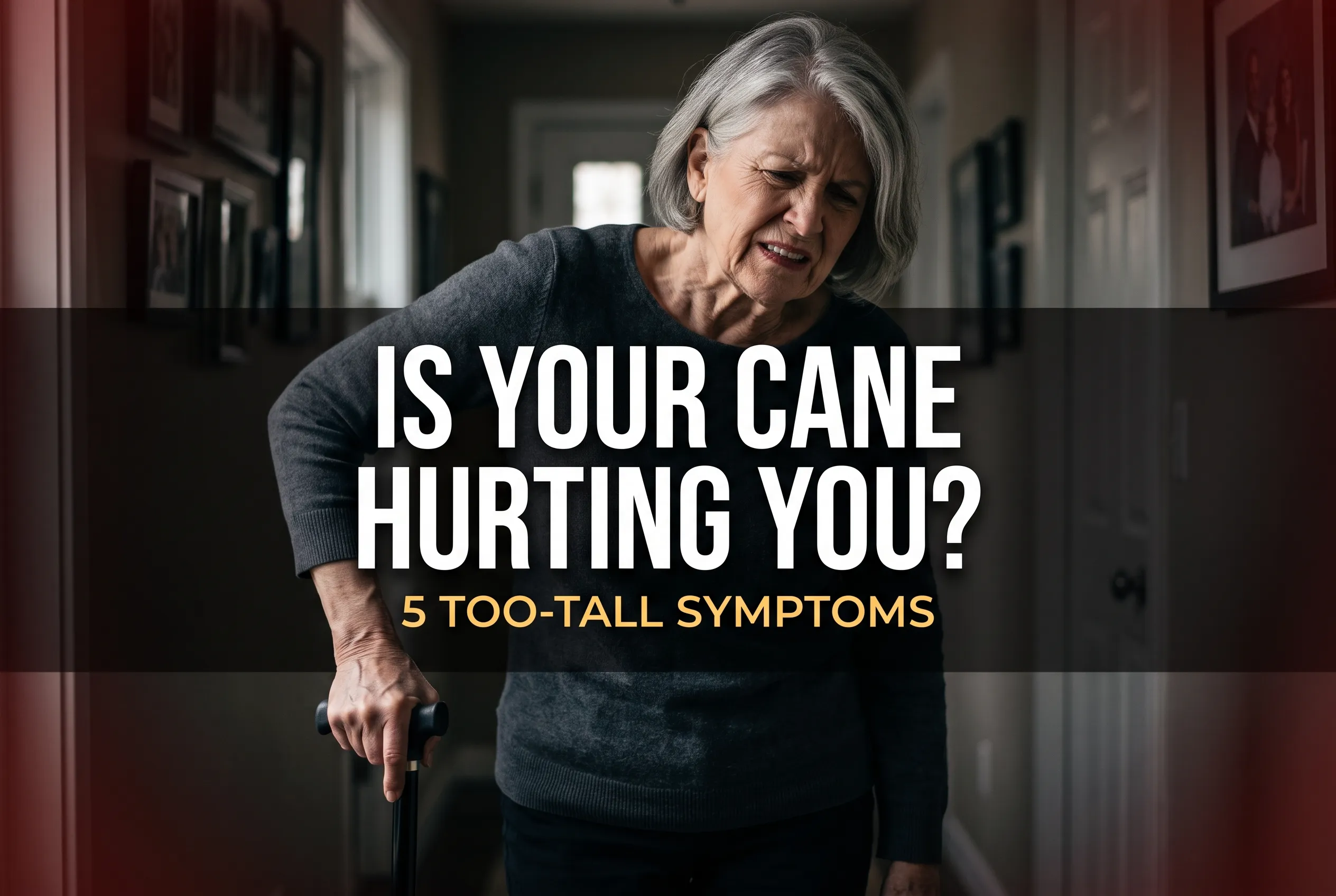
Short answer: yes, a cane or walking stick can cause shoulder pain. The most common reasons are a cane that’s too tall (your shoulder hitches up), holding it too far from your body, or leaning on it too heavily. Fix the height first. Most people feel a difference within a few days.
You started using a cane to take pressure off a sore hip or knee, and now your shoulder hurts instead. It’s frustrating, and very common. The good news is that it’s usually a setup or technique problem, not something you just have to live with.
The usual causes
1. The cane is too tall
This is the number one cause. If the handle is above your wrist crease, your elbow bends too much and your shoulder lifts every time you lean on it. Over hundreds of steps, the muscles across the top of your shoulder and neck get sore. Check the signs in is my cane too tall?, and reset it with our cane height calculator.
2. The cane is out to the side
Planting the cane far from your body turns your arm into a lever, and the shoulder takes the strain. Keep the tip about 4 to 6 inches from the side of your foot.
3. Leaning too hard
A cane is meant to take some of your weight. If you’re pushing down with a lot of force on every step, your shoulder and wrist will complain. That’s a sign you may need more support, such as a quad cane or a walker. See cane vs walker vs rollator.
4. Gripping too tightly
A thin or hard handle makes you clench, and that tension travels up the arm. A wider, softer grip helps. See cane handle types.
5. Wrong hand, or a shoulder problem on that side
The cane normally goes in the hand opposite your weaker leg (why). If that shoulder already has arthritis or a rotator cuff problem, talk to your doctor or physical therapist about options.
Quick self-check
- Stand tall in your usual shoes, arms relaxed. Does the handle line up with your wrist crease?
- Hold the cane. Is your elbow only slightly bent, with your shoulders level?
- Walk a few steps. Is the cane close to your side, not out wide?
- Is your grip relaxed, or are your knuckles white?
Fixes that help
- Lower the cane by one notch if in doubt. Many people set it too high.
- Use a lighter cane. Carbon fiber or light aluminium means less lifting. See cane materials.
- Try an offset or ergonomic handle so your weight goes straight down the shaft.
- Relax your shoulders as you walk. Drop them away from your ears.
- Take breaks on longer walks.
- Ask for an assessment if pain continues. A physical therapist can check your technique and suggest exercises.
When to see a doctor
- Pain that lasts more than a couple of weeks after fixing the height
- Pain at night, or pain that stops you lifting your arm
- Numbness or tingling down your arm
- A shoulder that feels weak or “catches”
Frequently asked questions
Can a walking stick cause neck pain too?
Yes, for the same reasons, especially a cane that’s too tall, which keeps your shoulder raised.
Should I switch hands to rest my shoulder?
Switching hands changes how well the cane supports your weaker leg, so it’s not usually the best fix. Correct the height and technique first, then ask a therapist.
Can a cane cause wrist pain as well?
Yes. Wrist pain often comes from a bent wrist on a crook handle. See wrist pain from using a cane.
Sources
- MedlinePlus: Using a cane
- MedlinePlus: Mobility Aids
Medical note: This article is for general information only and is not a substitute for professional medical advice. Talk to your doctor or physical therapist about your specific condition. Read our full medical disclaimer.

Written by
Health & mobility writer
Tariqul has a background in health sciences and experience in patient education and health communication. He writes practical, easy-to-follow guides on walking canes and mobility, based on trusted medical sources such as MedlinePlus.


