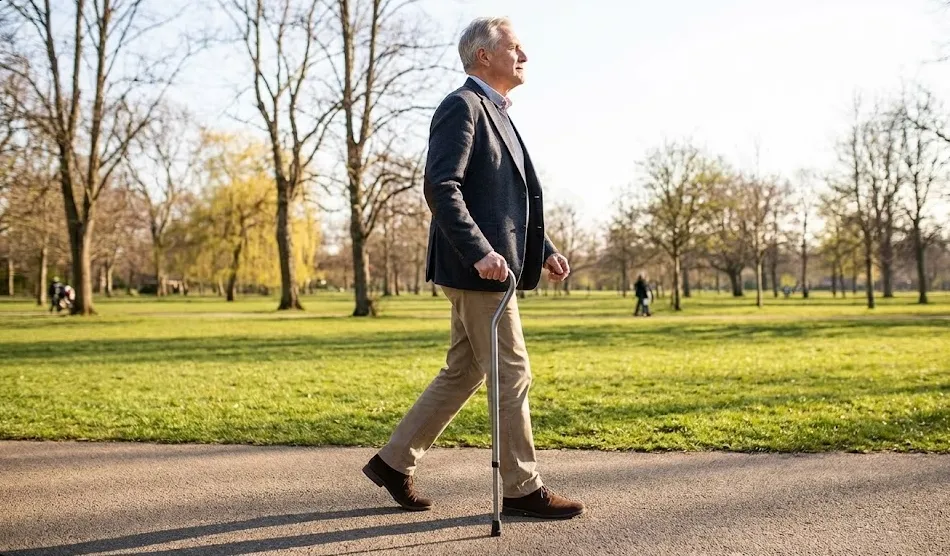
A cane is not just a stick. It is a tool for independence. It gives you speed, confidence, and freedom.
However, most people use it wrong. They hold it in the wrong hand or set the height incorrectly. This leads to back pain and a permanent limp.
You can fix this today. Learn the correct technique, sizing, and safety tips in under five minutes.
First: Size Your Cane Correctly
Do not skip this step. A cane that is too tall forces you to lift your shoulder. A cane that is too short makes you lean forward and hurts your back.
Follow the “Wrist Crease Rule” for a perfect fit:
- Stand Tall: Wear your regular walking shoes. Stand on a hard, flat floor.
- Relax Your Arm: Let your arm hang naturally at your side. Do not lock your elbow.
- Measure: The top of the cane handle must line up with the crease of your wrist.
Read our full tutorial: Walking Cane Height: How to Measure for the Perfect Fit.
When you hold the handle, your elbow should bend slightly (about 20 degrees). This bend acts as a shock absorber.

Top Recommended Adjustable Canes


Which Hand Do You Use? (The Golden Rule)
This is the most common mistake. Logic suggests you should hold the cane on your “bad” side to protect it. That is wrong.
The Golden Rule: Hold the cane in the hand opposite your weak or injured leg.
- Right Knee Hurts? Hold the cane in your Left hand.
- Left Knee Hurts? Hold the cane in your Right hand.
Read the full explanation here: Which Side to Use a Walking Cane? (The Golden Rule).
Why? Think about how you walk. When your left foot steps forward, your right arm swings forward. This is natural mechanics. Holding the cane in the opposite hand mimics this motion. It balances your weight and reduces the load on your bad knee.

The 3-Step Walking Rhythm
Now that you have the right setup, focus on the rhythm. Do not rush.
Follow this sequence:
- Cane + Weak Leg: Move the cane and your weak leg forward at the same time.
- Plant: Touch the cane tip firmly to the ground.
- Strong Leg: Step through with your strong leg.
How to fix a limp: If you still limp, you are likely taking steps that are too long. Shorten your stride. Focus on the timing: Cane-Step, Strong-Step.

Handle Stairs Like a Pro
Stairs are dangerous if you rush. Gravity works against you here. Memorize this simple phrase: “Up with the Good, Down with the Bad.”
Going Up Stairs:
- Step up with your Strong (Good) leg first. It lifts your body weight.
- Bring the cane and your weak leg up to the same step.
Going Down Stairs:
- Put the cane down on the lower step first.
- Step down with your Weak (Bad) leg.
- Bring your strong leg down last.
Check out our safety guide: How to Walk on Stairs With a Cane: The Safe & Easy Way.

Pick the Best Cane for Balance
💡 Expert Tip: Looking for maximum stability?
Check out our Pillar Guide: Walking Cane with Feet Review: Best Options for Balance & Stability.
Different canes serve different needs. Choose the one that matches your lifestyle.
| Cane Type | Stability | Weight | Best Use |
|---|---|---|---|
| Offset Handle | Medium | Light | Daily balance, knee pain, arthritis. |
| Quad Cane | High | Heavy | Stroke recovery, severe vertigo. |
| Folding Cane | Low-Medium | Very Light | Travel, car storage. |
Offset Handle: This is the best all-around choice. The handle shape centers your weight over the shaft for better stability.
Quad Cane: This has four tips at the base. It stands on its own. It offers maximum support but is heavier to lift.


Specific Tips for Pain Relief
How you use the cane changes based on your pain.
- For Back Pain: Keep your back straight. Do not hunch over the cane. Use the “opposite hand” rule. This balances the load on your spinal muscles and prevents twisting.
- For Knee Pain: Press down on the cane before you place your weight on the bad leg. This transfers pressure into the ground through your arm, saving your knee.
- For Post-Injury: Start with short walks inside your home. Trust the cane, but do not lean your entire body weight onto it unless necessary. It is a support, not a crutch.
Avoid These Common Mistakes
Bad habits limit the effectiveness of your cane. Avoid these rookie errors.
- Looking Down: Watch the path ahead, not your shoes. Looking down ruins your posture.
- The “Furniture Surf”: Do not grab chairs or tables as you walk. Furniture slides. Use your cane instead.
- Ignoring the Tip: Check the rubber tip monthly. If the tread is worn smooth, it becomes a slip hazard.
Community Insight: Users on r/PhysicalTherapy recommend using an “Ice Tip” attachment in winter. Standard rubber tips harden and slide on cold pavement.
Community Insight: On Quora, users discuss the “stigma” of looking old. The consensus is clear: Walking confidently with a cane looks better than falling and breaking a hip.

Frequently Asked Questions (FAQs)
What is the correct way to walk with a cane for balance?
Hold the cane in the hand opposite your weak leg. Move the cane and weak leg forward together. Keep your head up and back straight.
Do canes help with balance issues?
Yes. They widen your base of support. This gives you a “third leg” to stabilize your movements.
What are the disadvantages of using a cane?
It occupies one hand, making it hard to carry items. It can also cause wrist fatigue if the handle is too hard.
Which leg goes first when using a cane?
The cane and the weak leg go first. They move as a team.
Final Thoughts: Walk With Confidence
Using a cane is a skill. It takes practice.
Start inside your home. Clear the rugs and hallways. Once you trust the “Opposite Hand” rule and the “Wrist Height” setting, you will walk straighter. You will feel safer.

Tariqul
Tariqul is a dedicated health and wellness blogger with a background in health sciences. With years of experience in patient education and health communication, he focuses on providing accurate, easy-to-understand information to help readers make informed decisions about their well-being. Passionate about bridging the gap between clinical knowledge and everyday life, Tariqu ensures his content is both practical and medically sound.